
“Txotx” (pronounced “choch”) is one of my favorite words in any language. Hearing it usually means that 1) I’m in a Basque cider house, in the middle of tucking into traditional culinary delights, and 2) we’re being called to sample another one of the many casks of refreshing fermented juice from pressed apples, each with its own character and flavor notes.
The Basque word for cider is “sagardoa,” where “sagar” means apple, and “ardoa” is wine. This apple wine is produced in six of the seven historic Basque provinces, with Zuberoa being the lone exception, but well over 90% is produced in the province of Gipuzkoa. Basque cider has no added sugar and is dry, with no added carbonation.
The town of Astigarraga is the center of cider production, with 21 traditional baserriak or farms, each producing their own private label. Demand is so great in Gipuzkoa that they import two thirds of their apples from elsewhere in Europe to satisfy all of it.
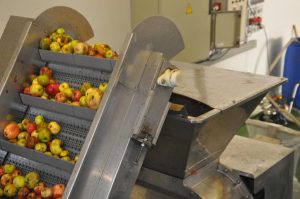
This lovely elixir has been part of Basque culture going back at least to the 10th century and likely well before. References to the production and distribution of cider can be found in ancient Basque legal texts, and casks of sagardoa even accompanied Basque whalers on ships that reached North America, according to historical records. The cider cask was a convenient store of essential plant-based nutrients that kept sailors healthy and hydrated on long sea voyages, with zero spoilage.But what I’m here to talk about is the consumption of this delicious nectar at its place of production, at the sagardotegi (ciderhouse). For most of the year, while the apple trees are cared for, apples are picked and pressed and the sweet juice is left to ferment in casks, these cider houses are closed to the public. Once the cider has completed its fermentation process in the tanks and casks sometime in mid-January, the doors of the cider house, or sagardotegia, are thrown open to the public for nightly sessions of eating and cider-sampling.
MORE STORIES about FOOD and DRINK
The ciderhouse season traditionally ended sometime in April, although as popularity has increased, we’re seeing some places extend their season into May and beyond. A select few are now bucking tradition and opening year-round, to the delight of many enthusiasts.
My first visit to a sagardotegi was in the 1980s, when most locales followed a standard formula, whereby each group attending brought their own txuletas or steaks, with the house providing the rest of the set-up, plus all the cider you could drink, for a set price. The house also provided grills where you prepared your own meat, which was eaten standing up, thus facilitating frequent trips to the casks or kupelak, sampling each in turn while enjoying the food.
The Traditional Ciderhouse Meal
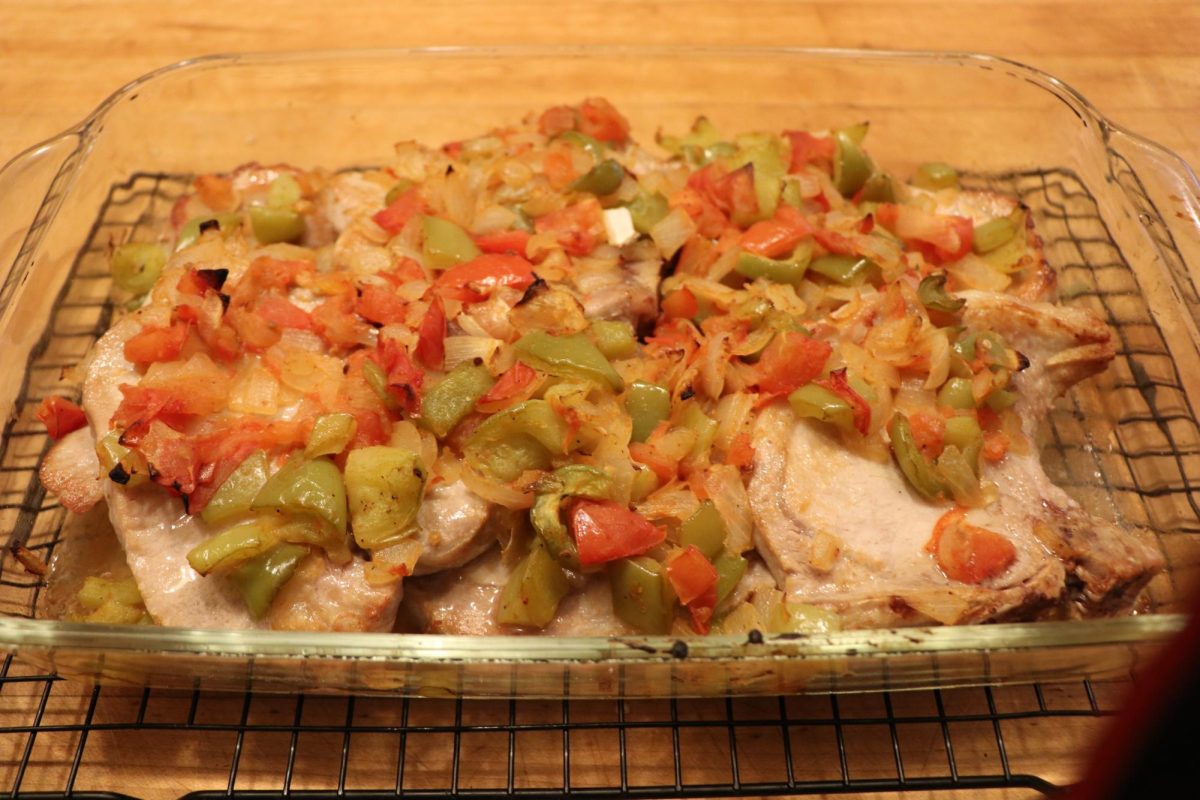
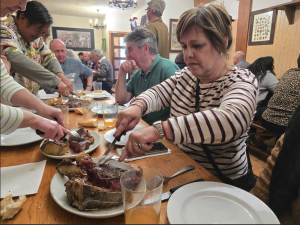
The standard set-up begins with chunks of salt cod (bakailua) served with fried green peppers (piparrak), followed with a salt cod omelette (tortila). The txuleta that comprises the main course is a massive, bone-in cut, separated by the butcher from a side of beef not by saw, but with the meat hatchet used by Basque butchers since time immemorial.
This tasty, local, grass-fed beef is seasoned with nothing but salt, seared on the outside and red on the inside, then cut by the grill master into individual strips and served on a communal platter. I like to call dibs on the bone and gnaw on the flesh caveman-style but I’m a bit of an outlier. The dessert that follows consists of local cheese (gazta), local almond confections called Tolosako teilak eta zigarretak, quince paste (menbrilo), and walnuts (intxaurrak), which often are brought all the way from California!
Due to stricter European health regulations, you no longer find yourself sharing your eating space, as I did on that first experience, with the cattle that reside at the baserri the rest of the year. Also, nowadays benches and tables are typically provided. Traditionally the meal was taken standing up, which also facilitated quick trips to the cask area for cider samples.
At today’s more modern sagardotegia, the house provides all of the food and preparation. You pay a set fee and everything is brought to your table. Many establishments now offer additional vegetarian or pescatarian options. It’s fairly common for there to be a mid-day seating, and there are some sagardotegiak that open all year round, so that you can get your cider house fix even if you’re visiting in the middle of the summer.
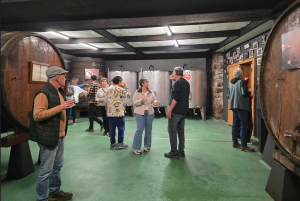
At this point, if I still have your attention, you’re still wondering what this word txotx is about? The Basque word txotx refers to the little stick jammed into the cask, pulled out when ready to dispense some cider. When the caskmaster is about to pull this stick from the cask and offer up a stream of cider to all in the vicinity, “TXOTX!” is the call to action. Nowadays, rather than a stick jammed into a small hole, most casks are equipped with a small spigot that serves the same purpose. Here’s how the ritual works:
“Txotx Time”
1. “TXOTX!” is called.
2. All interested assemble near the cask, in line, taking up a position to get a swallow of cider.
3. When your turn comes, have your glass ready behind the person in front of you. We want to keep the stream going without wasting a bunch of it on the floor.
4. Hold your glass as far from the spigot as possible, letting the stream fall down to your glass, “breaking” the cider and bringing out all of its effervescence. Watch and learn from others, it’s not that hard!
5. As soon as you have a few ounces, step away and let the next person get their sample. For the optimal experience, you’ll want to drink it as soon as it’s been served. This means taking small, but frequent samples. It’s perfectly fine to sip your glass, then get back in line for another sip before the spigot has been turned off.
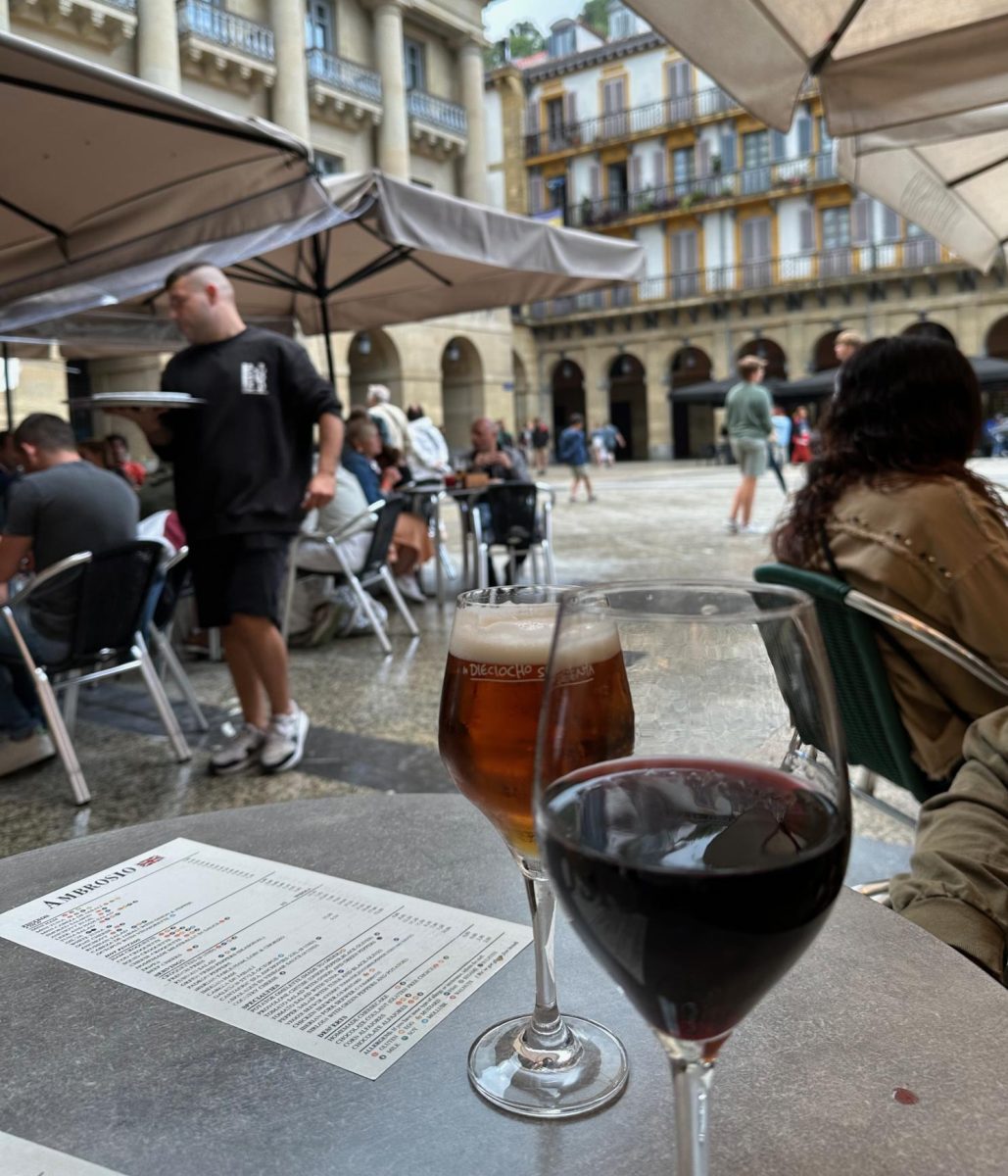
I enjoy going back and forth from table to different casks, comparing the character of each, and returning to the ones that I’ve especially liked. That said, if you prefer to just stay at your table, many establishments will bring you a steady supply of bottled cider that you can enjoy at the table without interrupting your meal. If you haven’t acquired a taste for cider and prefer to have some red wine accompany your meal, like many a French daytripper that arrives on a tour bus, that can also be arranged.
As is common at any Basque celebration, the food and drink are a big part of the evening, but not all of it. Music often figures heavily into the experience. You may get to hear a few improvised verses sung by bertsolariak, or a trikiti session offered by a strolling pair on the accordion and tambourine singing in delicious harmony. Occasionally you’ll be dining with a large group that will pause between courses to belt out traditional songs. The activity of sampling from the different casks lends itself to fun and engaging conversation with fellow cider aficionados and cider house staff. So the cider house experience is more than just a meal, it’s an event in itself. TXOTX!
McCay’s List of Ciderhouses
Here’s a list of the ciderhouses that I’ve visited over the years, all located in the province of Gipuzkoa:
Aialde Berri Sagardotegia – Santu Enea Auzoa, 37, Usurbil. A nice intimate experience in a natural setting, well worth visiting when cider is in season.
Begiristain Sagardotegia – Originally at Iturrioz Baserria in Ikastegieta, now located at Guadalupe Auzoa, 14 in Legorreta. This was my first ciderhouse experience in the 1980s, and I was back for a repeat trip in the 1990s. At that time, diners shared their dining area with barn animals and brought and grilled their own txuletas. For better or worse, that sort of experience no longer exists.
Izeta Sagardotegia – Urdaneta Bidea, Aia. Although officially in Aia town limits, this is located in the hills above Zarautz, with some amazing views. Open all year, there is not a huge emphasis on the txotx experience but they have won awards from various travel guides. The family running this operation has produced a number of champion harrijasotzaileak (stonelifters).
Lizeaga Sagardotegia – Martutene Pasealekua, 139, Donostia. While its address is officially Donostia/San Sebastián, it’s more associated with the town of Astigarraga, home to several ciderhouses and thought of as the core of cider production in Gipuzkoa. This was my go-to sagardotegia of choice in the 1990s, where meals were consumed standing up in a dining area with the casks within arm’s reach.
Ola Sagardotegia – Meaka Auzoa, 102, Irun. Built in a stone ironworks building dating back to the 13th century, while inside, you feel like you’re in a castle dedicated to eating and drinking. It was inaugurated as a sagardotegia in 1999 by Iñaki Bengoetxea, a champion segalari (traditional Basque sport of cutting grass with a scythe) and promoter of Basque sport and culture. A great place to enjoy a meal and music session.
Petritegi – Petritegi Bidea, Astigarraga. A large operation, this was probably the first sagardotegia to tap into the demand for the ciderhouse experience any time of year. They also offer guided tours that explain the entire process, from growing and picking the apples, to pressing, fermentation and bottling.
Saizar Sagardotegia – Kalezar Auzoa, 39, Usurbil. An “undiscovered” alternative to Petritegi, it is open year-round but has not yet been overrun by tour buses.
—
Michael McCay, who lived in the Basque Country for many years and speaks Euskera fluently, is a travel agent with Overtrails. He can book accompanied, all-inclusive ciderhouse experiences for groups of all sizes from the U.S. As part of a locally based travel company, he can help solo travelers, families and large groups visit the Basque Country with customized itineraries or affordable group programs.
Read more here about Overtrails’ services and itineraries. To contact Michael McCay directly, email him at [email protected].