
Basque
Kaixo
Egun on
Arratsalde on
Gabon
Agur
Zer moduz?
Ongi etorri
Barkatu
Mesedez
Eskerrik asko
English
Hello
Good morning
Good afternoon
Good night
Goodbye
How are you?
Welcome
Excuse me/sorry
Please
Many thanks
From Basque-ing in Language Learning
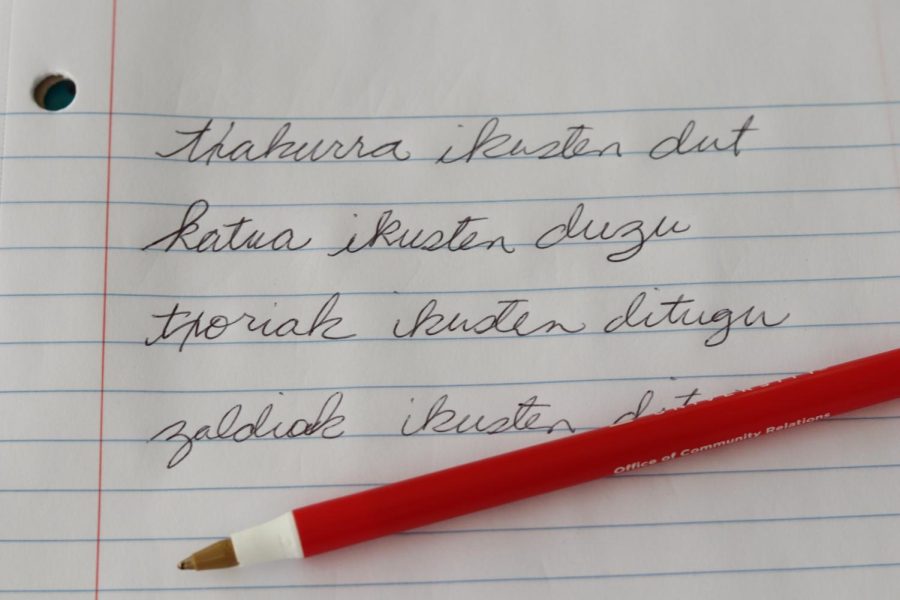
I remember when I first began to learn Basque. The difficulty was in a whole different league compared to learning Spanish. As my first non-Indo-European language, I encountered many features that just didn’t make sense. For instance, if you want to say, “a cat,” the translation is literally “cat a.” And that was just the beginning of the difficulties. Despite these challenges, I bought Beginner’s Basque by Wim Jansen and started my learning journey. Basque was the only language that truly frustrated me while learning.
I also was held back by the lack of resources for beginners. Of course, this was to be expected, as Europe’s only surviving pre-Indo-European language has less than a million native speakers. But it wasn’t until several years into my learning journey that I realized somebody should do something about this problem.
One morning, I got the idea to write “Basque-ing in Language Learning,” a play on the verb ‘to bask.’ I had always commented on the lack of beginner’s resources, but this was the first time I connected the dots. One night while I was stargazing and planning the book in my head, I wondered: What if it was funny? Why can’t it be casual and sarcastic? Most other language instruction manuals are dry and boring. So, I set out to write the resource I wish I had as a beginner.
More Stories About Learning Euskera
Basque is difficult for a native English speaker. If you ever studied it, you would be perplexed by a myriad of exotic traits. Verbs and articles that appear at the end of sentences are one problem. But you also will find yourself swimming in an endless sea of grammatical suffixes. Even the form of the verb can change depending on who is doing the action, who is receiving it, and even how many objects are being given. Thus, Basque is truly a puzzle that keeps getting more complicated the more you advance your learning. But good news — the pronunciation is easy to learn.
“Basque-ing in Language Learning” takes a difficult language and breaks it down in an unintimidating manner. The tone differs from your typical language book as it can be casual and sometimes sarcastic. It teaches the basics all the way up to suffixes and the Nor-Nori-Nork agreements. Instruction includes trivia on Basque culture, history, and even mythology. There is even a ‘Bonus Chapter’ to introduce you to the basic differences between dialects. Because, if you thought it wasn’t hard enough, the language can change whether you are in Bilbao, Bayonne, or any other part of Euskadi. Ultimately, the book teaches through stories that include John Adams’s trip through the Basque Country, the Basajaun, the Labourd witch trials, and more.
And more recently, I published Basque-ing in Verbs. As the name says — it’s all about verbs! This short book is a straightforward, no-nonsense introduction to Basque verbs. It lacks the stories and humor (well, maybe there are a couple jokes) of “Basque-ing in Language Learning,” but keeps the straightforward instruction. Tenses and moods from present continuous to hypothetic are covered. Even if you have been intimidated by the Nor-Nori-Nork agreements, don’t worry, they will be explained directly and simply. This book is a perfect supplement to any Basque learning plan. (The newer “Deluxe” version of his book now available on Amazon is a compilation of the two books. He also has a Field Edition that is very inexpensive and helpful for travel in the Basque Country. All his editions are also available for Kindle.)
With a wider range of resources, Basque, a language which has already survived against all odds, will have a greater chance of surviving into the future. Those in the Basque diaspora as well as curious language enthusiasts will learn to speak such a beautiful language. My wider future goals involve using this approach to create more resources for other minority languages, so that they can survive and thrive as well.
Madill, who speaks Spanish and Portuguese fluently, took on Basque because of his interest in Iberian languages. As a geologist, he enjoys taking something that is scary and complex — like the Basque language — and making it approachable. Madill, who is from Pennsylvania, enjoys journaling in Basque and listening to music in Basque and breaking down the lyrics.
Madill is interested in publishing a sequel, a book for intermediate Euskera learners. He would be happy to hear from language learners about what they would like to see in such a book. Write to him at [email protected].
At no additional cost to you, we earn a commission on the links provided here if you click through and make a purchase. These are all products that we recommend.