
Baiona, Iparralde
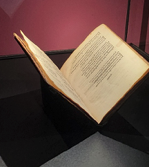
For the holiday season, the Basque Museum in Baiona, France received a guest that had not been home in centuries. It is small, fragile, and unassuming in appearance, yet the book holds great importance as the oldest written legacy of the Basque people.
Linguae Vasconum Primitiae, the first book ever printed in the Basque language, arrived in Baiona on Oct. 11, 2025 as part of the museum’s centenary exhibition titled “LINGUÆ VASCONUM PRIMITIÆ – 1545 The Beginnings of the Language of the Basques.”
Loaned by the Bibliothèque Nationale de France in Paris, the book was scheduled to return to the French capital this January. The volume resides in Paris not because of any cultural affinity, but because it is the property of the French State, held in the national archives which possess the only known copy in existence.
However, a coalition of Basque language activists, cultural organizations and local politicians has launched a campaign to keep the book in the Basque Country permanently. They argue that the volume, written by the priest Bernard Etxepare in 1545, is not merely a French archival artifact, but the soul of Basque literature.
The Man Who Printed a Language
To understand why this small book generates such passion, one must look at the man who wrote it. Bernard Etxepare was not just a remote historical figure; he was a man of the Renaissance deeply involved in the turbulent life of 16th-century Nafarroa.
Born between 1470 and 1480, likely in the town of Sarrasketa, he served as a rector in the town of Saint-Michel, though his writings reveal a deep love for Donibane Garazi (St. Jean Pied de Port), which he considered his true home. His life was far from the quiet existence of a monk; he lived through the political upheaval of the conquest of Nafarroa and was even imprisoned for a time -— a difficult episode he chronicled in his autobiographical poem Mossen Bernard Echaparere Cantuya.
In 1545, Etxepare faced a major hurdle: he wanted to do something that had never been done: print a book in Euskara. But there were no printing presses in the Northern Basque Country capable of the job. Determined, he traveled north to Bordeaux to the printing house of François Morpain.
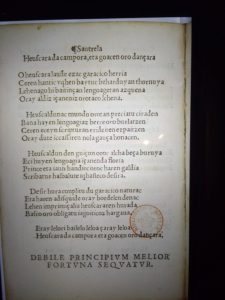
The result was a collection of 15 poems that range from religious devotion to surprisingly bold romantic verses, and his personal accounts of imprisonment. But the book is most famous for its final two poems, Kontrapas and Sautrela, which are passionate defenses of the Basque language.
Etxepare created these verses not just to be read, but to be sung in town squares, using the rhythms of popular dances. It is a wish that came true centuries later. Modern cultural icons like singer-songwriter Xabier Lete and the folk group Oskorri set these poems to music, turning 16th-century rhymes into contemporary anthems of identity known by many Basque speakers today: the songs Kontrapas and Sautrela (see the videos below).
“It is important to see that there is a 16th-century book written in Basque that shares concerns we still have today,” says Maddi Kintana, a researcher and PhD candidate at the University of the Basque Country and a Basque instructor in Baiona.
A “Sit-In” for Etxepare
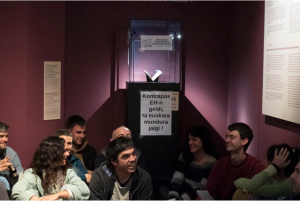
On Dec. 3, coinciding with the International Day of the Basque Language, the reverence for these verses turned into action. Members of the group Euskal Herrian Euskaraz (EHE) staged a peaceful “sit-in” inside the museum.
Surrounded by the museum’s collection, they sat on the floor and sang “Kontrapas.” By singing the very words displayed in the glass case — “Heuskara, jalgi hadi kanpora” (Basque, go forth outside) — they bridged a 480-year gap. Their message was clear: they would not leave until a dialogue was opened regarding the book’s permanent repatriation.
The cultural demonstration drew immediate attention. Local officials including Baiona Mayor Jean-René Etxegarai arrived at the museum to speak with the activists. The mayor committed to a meeting to discuss the possibilities of keeping the book.
True to his word, a high-level meeting took place Dec. 22. It included Mayor Etxegarai, EHE representatives, and Maylis Descazeaux-Roques, the Regional Director of Cultural Affairs representing the French state.
The Struggle to “Go Out” in Iparralde
The irony of Etxepare’s call for the language to “go forth to the plaza” is not lost on today’s Basque speakers in Iparralde (the Northern Basque Country, France). While Etxepare dreamed of a prestigious language used by nobles and commoners alike, Euskara today faces a complex reality in the historical territory where the author lived.
Unlike in most of the Southern Basque Country (Hegoalde), Euskara has no official status in the Northern Basque Country.
The fragility of the language is evident in the data. According to a 2021 government study, only 20 percent of the population in Iparralde -— approximately 51,500 people -— are Basque speakers.
However, the survey reveals a shifting landscape. While the highest density of speakers remains in the older generations (over 65) and in the rural provinces of Baxe-Nafarroa (Lower Navarre) and Zuberoa (Soule) — where nearly half the population speaks the language, a quiet revolution is happening among the youth.
For the first time in decades, the decline of the language has stalled, and the trend is reversing among the youngest generation. The survey shows that 22% of those aged 16 to 24 are Basque speakers, a figure significantly higher than the 25-34 age group. This “youth revitalization” suggests that transmission efforts are finally beginning to bear fruit, though the reality on the ground is complex.
“Most of the young people I interviewed did not have two Basque-speaking parents, so they learned in the ikastola,” explains Kintana, about her study of youth speech in Baiona. However, she notes that these new speakers are making a conscious choice to use the language socially, particularly in the local gaztetxe (community-based youth centers). “I have seen a big link with the gaztetxe,” Kintana observes. “So there is that intention to make the jump to the plaza.”
Yet, she warns that without official status, the language often remains trapped in a specific cultural sphere. “It exists in a tension,” Kintana adds. “They have taken it out of the school, but it often stays within those walls. You won’t find a hairdressing course or a cooking class in Basque here. It is still limited to a reduced space.”
This limitation puts immense pressure on the education system. While family transmission remains the most effective method when both parents are speakers, the reality of mixed households means that the school system has become the vital artery for the language’s survival. Because the public school system is French-monolingual by law, parents who wish for their children to be literate in Basque must often rely on the Seaska Federation of Ikastolas (all-Basque schools).
Founded in 1969, Seaska has grown to a network of 34 schools. Yet, resources are limited. The Bernat Etxepare Lizeoa in Baiona is the only high school in the entire Northern Basque Country that offers a full immersion curriculum. Students from across Lapurdi, Baxe-Nafarroa, and Zuberoa must often board there to access education in their mother tongue.
As Iparralde and southern Nafarroa are the only places in Euskal Herria where Basque does not enjoy official status, those who want their children to study in Basque must invest significantly in their education. This context turns the location of the book into a political symbol. For the foundational text of the language to reside in Paris —- the capital of a state that does not officially recognize that language -— is seen as a insult to some.
A Technical Solution
Mayor Etxegarai has formally asked the French Minister of Culture to consider moving the book permanently to Baiona. In a letter sent on Dec. 23, Etxegarai argued that Baiona possesses the technical capabilities to satisfy the strict conservation laws, which require sensitive paper artifacts to rest for three years after a three-month exhibition.
The proposal suggests housing the book in the Baiona Library. Unlike a museum display case, the library has specialized facilities to keep the book in the necessary darkness and climate-controlled environment required for the mandatory rest periods.
The response arrived quickly. On Jan. 6, the French Minister of Culture formally replied to the Mayor. In her letter, Minister Rachida Dati committed to examining the request to keep the book in the Basque Country “as soon as possible.” This marks a significant shift, as it is the first time the central government in Paris has officially opened the door to a potential repatriation of the text.
The Center for Basque Studies of Reno, Nev. published an English translation of Etxepare’s book that can be purchased on Amazon.
As negotiations continue, the spirit of Etxepare seems more alive than ever. In 1545, he published Linguae Vasconum Primitiae to end the mockery of his language. Today, the community is mobilizing to ensure that the physical proof of their language’s survival returns home.
The song “Kontrapas” written by Xabier Lete based on Etxepare’s writings
The song “Sautrela” by Oskorri, based on Etxepare’s writings



Nico M • Mar 10, 2026 at 9:14 am
Beautiful article and great writing! It makes me so proud to see such a strong Basque community and their determination to preserve their language and culture!